
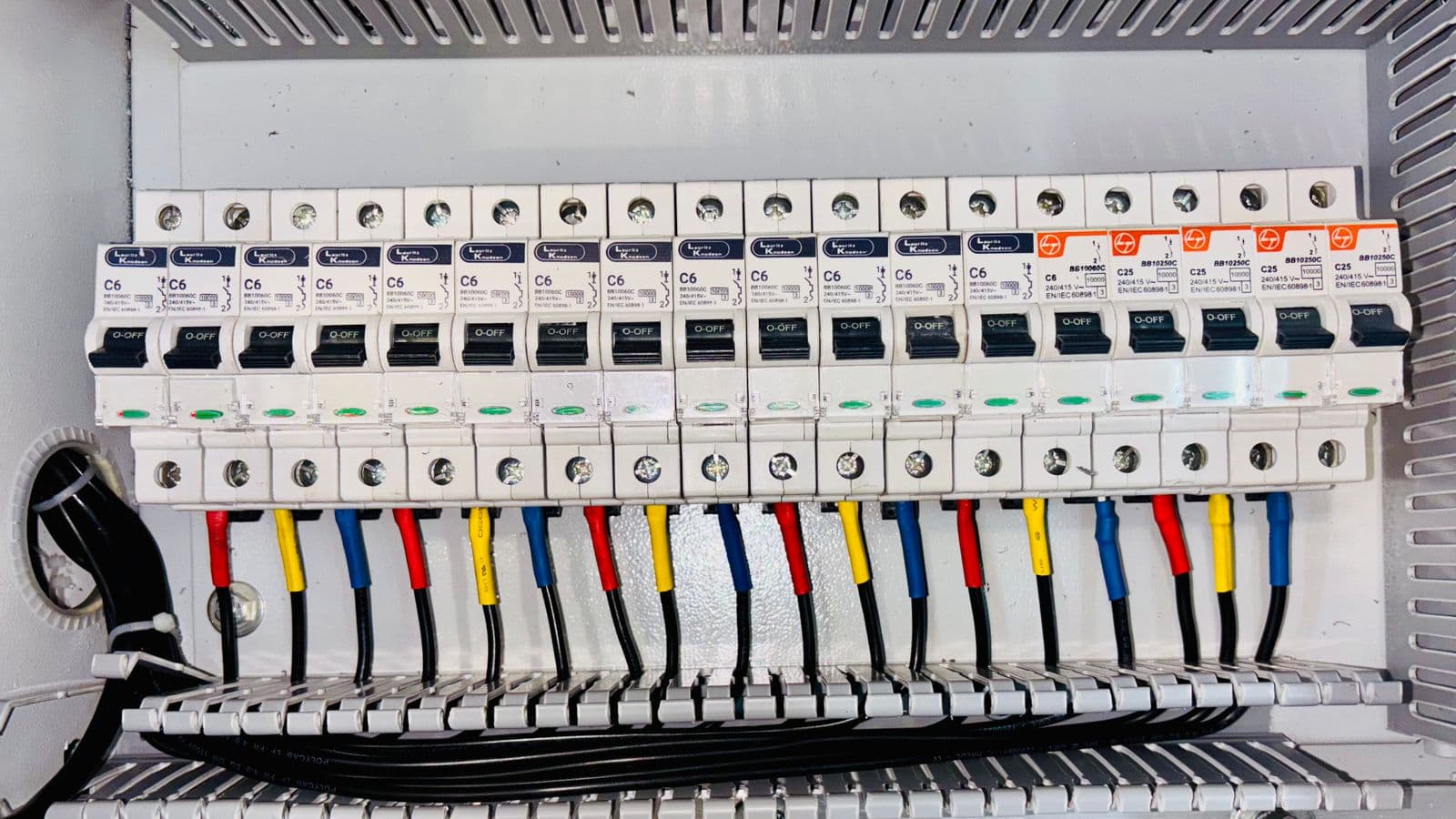
A factory's main distribution panel sets the ceiling on that facility's electrical growth. Years after the building is finished and the machinery is installed, hearing "we can't add another line because there's no room left in the panel" is a surprisingly common situation across Bursa's OIZs. When main distribution panel capacity isn't sized correctly, that ceiling directly halts production expansion, a new line, a new machine, or an added shift ends up requiring a panel replacement, an intervention that's nearly impossible to carry out without stopping production. This article covers how main distribution panel capacity is actually sized, busbar dimensioning, form/segregation classes, and the real cost an undersized panel imposes on a growing facility.
What Is a Main Distribution Panel, and Why Is It Central?
The main distribution panel is the first-tier panel that splits incoming power from the substation or grid connection point out to the facility's sub-distribution panels, MCCs, and large loads. Because all of the facility's electrical energy passes through this point, the panel's capacity, protection coordination, and physical layout determine the reliability of the entire system. A calculation error or missing growth margin at the main panel indirectly constrains every downstream panel too, no matter how much a sub-panel is expanded, the total power the main panel can feed is a hard ceiling.
Current Load Analysis: The Starting Point
The first step in capacity sizing is establishing the facility's total installed power (kW) and how much of that is actually drawn simultaneously under real operating conditions. Installed power is the sum of the nameplate ratings of every motor, lighting, heating, and process device; but this figure never reflects actual draw, since not all equipment runs at full load at the same time. For existing facilities, this means measuring the real load profile with a power analyzer over at least a week, ideally a full month covering shift changes and seasonal variation. For new facilities, this data is estimated at the design stage from the equipment list and process flow diagram. See our energy monitoring and bill reduction article for detail on this measurement process.
How Diversity Factor Is Applied
Summing every device's nameplate power and sizing the panel to that total leads to significant oversizing, and unnecessary cost. Diversity factor is a correction coefficient that accounts for the fact that not all loads in a facility run at maximum capacity simultaneously; applying it to installed power yields a realistic demand load. Two redundant pumps, for example, don't both run at full load at once; not every motor on a production line starts in the same second. Diversity factor is determined by the project engineer based on the facility's process flow, shift pattern, and equipment usage pattern, a standard table value can't be applied directly to every facility, because the diversity profile of a textile plant can differ substantially from that of a metalworking shop. An overly optimistic diversity factor leaves the panel undersized for actual load and causes overloading in operation; an overly conservative one results in an unnecessarily large and expensive panel.
Growth Margin: Sizing for the Future, Not Just Today
The main distribution panel must be sized not just for today's load but for the facility's reasonably foreseeable growth horizon, typically 5-10 years. A common practice in industrial facilities is to add a growth margin of roughly 20-30% to the calculated demand load, though this figure varies with the facility's sector, growth rate, and investment plans. Growth margin needs to be considered not just in the main breaker's current rating but in the busbar's physical mounting space, spare feeder slots, and enclosure expansion modularity, even if a panel's breaker has enough headroom, if there's no physical room to add a new feeder, the growth margin exists only on paper. This mirrors the growth-margin logic covered in our substation installation article for transformer power sizing, there's little point sizing the transformer for growth without sizing the panel the same way.
Busbar Sizing
The main panel's busbar system must carry a current rating that covers the calculated demand load, growth margin included. Busbar cross-section is set based on material (copper or aluminum), current density limits, and temperature-rise limits; copper is commonly used because it carries higher current density, while aluminum is lighter and more economical but requires a larger cross-section. Two separate current values are checked in busbar sizing: continuous rated current (normal operating load) and short-circuit withstand current (Icw), the latter determined by the grid fault power established in the short-circuit calculation. Even if a busbar handles continuous current without issue, if it can't withstand short-circuit forces, it can mechanically deform during a fault, or the short-circuit arc can travel between the bars.
Choosing Form and Segregation Class
The main distribution panel's segregation (form) class, under TS EN 61439-1, defines the level of separation between functional units inside the panel, incoming supply, outgoing feeders, metering section. Main panels commonly use Form 3 or Form 4, depending on the facility's downtime tolerance, this allows maintenance on one outgoing feeder while other feeders and the main bus stay energized. In facilities running continuous production (24/7), a high form level becomes nearly mandatory so a maintenance interruption on the main panel doesn't stop the entire factory. Cost rises with form level, so the choice should balance the facility's actual downtime cost against panel cost.
Main Breaker and Protection Coordination
The breaker on the main distribution panel must both carry demand load continuously and provide selective coordination with downstream protection devices. Without selectivity, a minor fault at a lower level, a short circuit on one outgoing feeder, say, can trip the main breaker too, cutting power to the entire facility over a fault unrelated to most of it. Main breaker selection and protection settings are made against the results of the short-circuit calculation; time-current selectivity curves are used to ensure each level sees and clears a downstream fault before the level above it does.
Metering and Monitoring Infrastructure
Modern main distribution panels serve not just as power distribution points but as a platform for facility-wide energy consumption monitoring. Multifunction meters placed on the main incoming feeder and on major load feeders collect real-time power, power factor, harmonic distortion, and consumption data. This data underpins both reactive penalty prevention and energy-efficiency projects. Physical space and communication infrastructure (RS-485/Modbus or Ethernet) for these meters should be planned from the start when sizing the panel, adding them later means opening the panel and pulling new cable.
The Real Cost of an Undersized Panel
As a factory grows, the consequences of an undersized main distribution panel emerge in stages:
- No room for new lines or machines: Once spare feeder slots or busbar capacity run out, the investment plan becomes hostage to a panel replacement.
- Overloading and heating: As demand load approaches the busbar's rated value, sustained high temperature ages insulation and raises failure risk.
- Unplanned full shutdown: Expanding or replacing the panel usually requires de-energizing the entire facility for a period, a direct production loss.
- High replacement cost: Expanding or rebuilding a panel later costs several times more, in equipment, labor, and lost production, than sizing it correctly from the start.
Common Mistakes
- Only considering growth margin in the breaker's current rating: When physical feeder space and busbar expansion room are forgotten, the growth margin on paper becomes unusable on site.
- Pulling diversity factor from a generic table: Every facility's load profile is different; a generic coefficient may not reflect real operating conditions.
- Treating metering infrastructure as an afterthought: Without space reserved for meters and communication cabling, retrofitting requires opening the panel and extra labor.
- Choosing form level on cost alone: A low form level can force a full production stop during maintenance at facilities with low downtime tolerance.
FAQ
How often should a main distribution panel be reviewed? This depends on the facility's growth rate, but a common practice is comparing the current load profile against panel capacity every 3-5 years and reassessing remaining growth margin.
Is a 20-30% growth margin appropriate for every facility? This range is a common starting point for industrial facilities, but fast-growing facilities or those with uncertain investment plans may want a higher margin; facilities expecting stable, limited growth can use a lower one.
Should busbars be copper or aluminum? Copper carries higher current density and can carry the same current with a smaller cross-section; aluminum is lighter and more economical but requires a larger cross-section. The choice depends on the panel's physical size constraints and budget.
Is Form 4 always necessary for a main panel? No. Form 4 is preferred for facilities requiring high downtime tolerance (24/7 production); single-shift facilities with more tolerance for interruption can usually get by with Form 3 at lower cost.
Is it better to expand an undersized panel or replace it entirely? This depends on the existing panel's structural condition, age, and enclosure/busbar expansion capacity. A structurally sound, expansion-ready panel in good condition may only need expansion; older, non-compliant panels are often safer and more economical to replace outright, see our panel replacement timing article.
Where should metering devices be placed in the panel? On the main incoming feeder without exception, and separately on major load feeders (large motors, compressors) so consumption distribution can be analyzed accurately.
What's the most common investment mistake in main distribution panel selection? Buying the panel sized strictly for today's needs at the lowest upfront cost. When capacity runs out within a few years, the panel may need a full replacement, turning the initial savings into a cost several times larger.
The main distribution panel is a factory's electrical spine, and that spine's capacity directly limits or enables the facility's growth rate. A panel sized with proper load analysis, a realistic diversity factor, and adequate growth margin prevents the "why can't we grow" question from ever being asked years down the line. Our LV panel installation service performs these calculations by evaluating your current and future load profile together.
Let's talk through this together
The SOREAS engineering team can assess what's covered here for your specific facility. Reach out via the contact form or call us directly.