
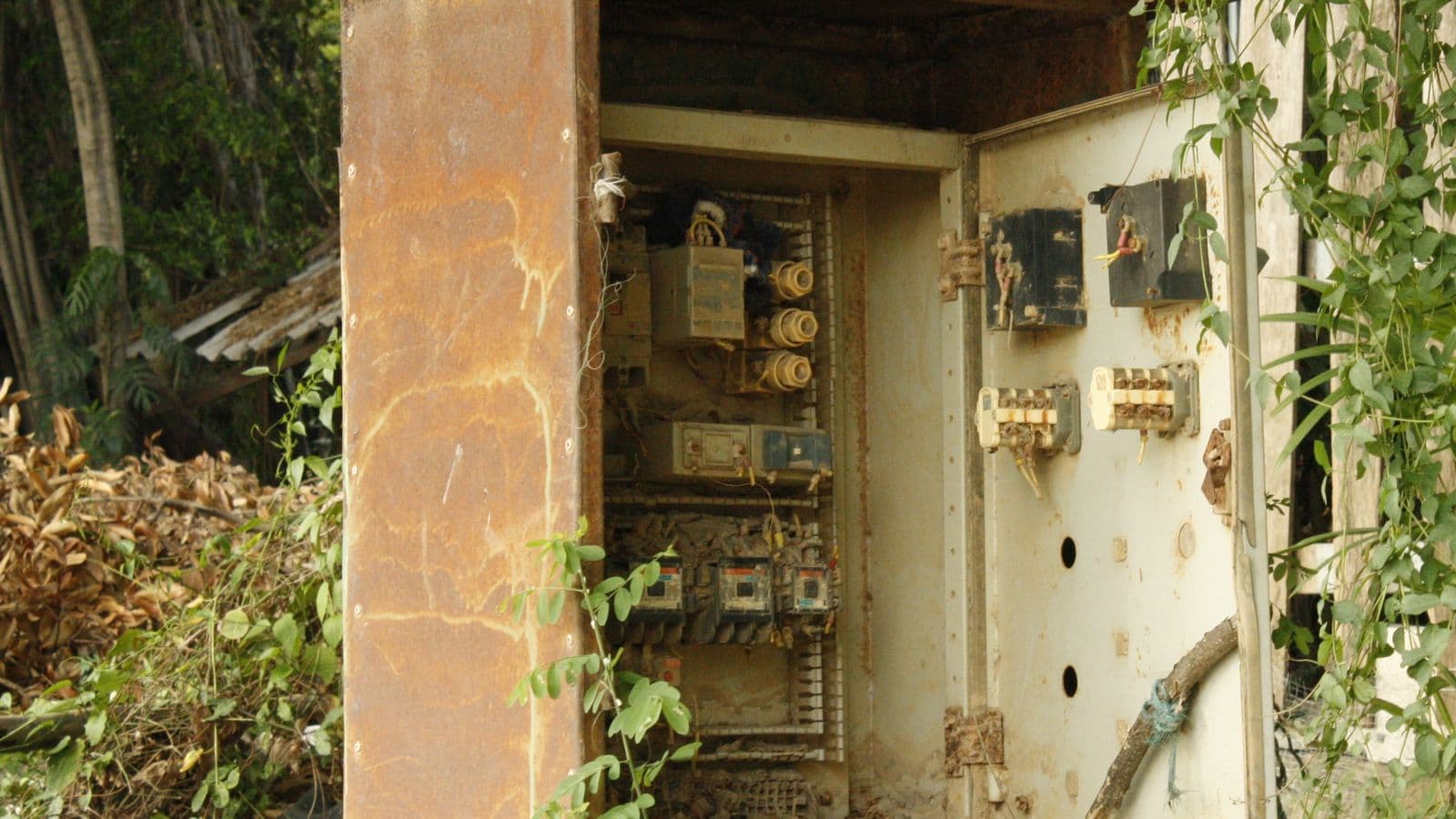
An electrical panel is a silent, invisible component in day-to-day operation, until something goes wrong. But trouble rarely appears all at once; a panel gives off small, easy-to-miss warnings for years before it fails, and when those warnings go unnoticed, the facility ends up facing an unexpected fault, lost production, or worse, an accident. Across Bursa's OIZs, a significant number of factories are still running production on panels over 15-20 years old, sized for a machine fleet that no longer resembles the one they now run. This article covers six concrete warning signs that an old panel needs replacement, why each one matters, and what to do when you spot one.
1. Discoloration and Heat Marks
If you open the panel door and see yellow-brown discoloration, bluish staining, or smell burning at busbar connection points, breaker terminals, or cable lugs, that's tangible evidence of overheating. Discoloration at electrical connection points is usually caused by a loosened connection, an overloaded circuit, or an oxidized contact surface, and if left unnoticed, this heating ages the insulation material over time, further raises contact resistance, and enters a self-reinforcing cycle (heating → rising resistance → more heating). That cycle's endpoint is usually thermal runaway or fire. What to do: Scan every discolored point with a thermal camera, check tightening torque, and replace the affected connection or component if needed. Widespread discoloration across the whole panel usually signals the panel's overall age and history of overloading, targeted repair should give way to a full replacement evaluation.
2. No Available Spare Parts or Discontinued Devices
When a breaker, contactor, or relay in an old panel fails, and the manufacturer can no longer supply a replacement part, or the device model was discontinued years ago, that's a serious operational risk. In this situation, facilities are usually stuck between two bad options: forcing in a mismatched substitute part (which risks coordination and dimensional mismatch) or leaving the faulted circuit out of service for an extended period. This problem shows up frequently in panels over 15 years old, especially with custom-order breakers and older-generation electronic relays, manufacturers eventually drop support for discontinued product families. What to do: Proactively confirm spare-part availability for critical components with the manufacturer. If parts can't be sourced for multiple components, replacing the panel, or the affected section, outright is safer and more economical long-term than scrambling for "the closest available" substitute part by part.
3. Repeated Nuisance Tripping
If a breaker or residual current device trips frequently without a clearly identifiable fault, this usually signals aging protection equipment, drifted settings, or a load profile the panel was never sized for. Nuisance tripping stops a production line unexpectedly, and over time it can lead maintenance staff to dismiss real faults as "just another nuisance trip", a form of alarm fatigue that lets an actual fault slip through unnoticed. Aging electromechanical protection relays can drift out of their set points; thermal relays can also lose sensitivity over time. What to do: On a circuit with repeated tripping, first run a load analysis (is there genuinely an overload), then check the protection device's calibration. If the device is malfunctioning purely due to age, a single device swap may suffice; but if multiple protection devices in the panel show similar symptoms, that's a sign the panel as a whole is aging out.
4. Non-Compliance with Current Standards
The regulations and standards in force when a panel was installed get updated over time; an old panel that was fully compliant at installation may no longer meet today's TS EN 61439-1 requirements. Typical gaps include an inadequate IP rating, missing segregation, busbar cross-sections that no longer match today's short-circuit levels, and protection coordination that doesn't meet current selectivity requirements. This non-compliance tends to surface specifically during an OIZ inspection, an insurance policy renewal review, or a workplace-accident investigation, and it exposes the business to both administrative and legal risk. What to do: Have the panel's current state assessed against today's TS EN 61439-1 requirements. Minor gaps (labelling, single-line diagram) can usually be fixed; but structural shortfalls (inadequate Icw, wrong IP rating) are usually solvable only by replacing the panel.
5. Insufficient Capacity for Added Load
As a factory grows, adds new machinery, or starts extra shifts, the panel's original capacity can become inadequate over time. This shows up in a few ways: no spare feeder slots left, the main breaker running near its continuous rating, or the busbar sitting at persistently high temperature. A panel running under insufficient capacity may look fine in the short run, but over time this results in overheating, insulation aging, and a rising fault risk. We cover this in more depth in our main distribution panel sizing article. What to do: Recalculate current and planned load profile and establish the panel's actual remaining capacity margin. If margin still exists, physical expansion (adding a new feeder) may be enough; if it's exhausted, replacing the panel removes the single biggest obstacle standing in front of production growth.
6. Corrosion and Enclosure Degradation
A panel enclosure can corrode over time, especially in humid, dusty, or chemically exposed environments. If you see rust, peeling paint, hardened or cracked gaskets, or loose door hinges on the enclosure, that's not just a cosmetic issue, it effectively lowers the enclosure's IP rating and lets moisture and dust seep in. Moisture seeping in lowers insulation resistance and causes internal corrosion on metal surfaces, compounding the problem from the inside. This risk is especially high in food production, chemical processing, or outdoor installations. What to do: Regularly inspect the enclosure inside and out, and check gasket and door seal integrity. Surface corrosion can be cleaned and recoated, but if structural corrosion is found, thinning or perforation in the enclosure walls, the enclosure can no longer be considered safe, and replacement becomes unavoidable.
Full Replacement or Partial Upgrade?
When one or more of these six signs show up, the first question should be "does the whole panel need replacing, or is a partial upgrade enough." The answer depends on the panel's structural condition (enclosure, busbar), its age, and the scope of the issues found. If a single component has failed and the panel is otherwise sound, a targeted swap may be sufficient. But if several warning signs appear at once, widespread discoloration, spare-part sourcing problems, and insufficient capacity all together, say, that signals the panel as a whole is nearing end of life, and piecemeal repair only keeps both rising maintenance cost and risk in permanent circulation.
A checklist helps with this call: is the enclosure and busbar structurally sound, does the current Icw rating still meet today's grid fault power, does the segregation class match the facility's maintenance needs, and can spare parts for critical components still be reliably sourced. If two or more of these four questions come back "no," the return on partial repair is limited, because structural issues outside the repaired section will simply reproduce the fault somewhere else. In those cases, full replacement is usually both safer and more economical over total cost of ownership (maintenance + downtime + repair) in the long run.
Common Mistakes
- Treating discoloration as a cosmetic issue: Heat marks are visible evidence of an underlying connection problem progressing, they shouldn't be ignored.
- Patching in a mismatched substitute part: A part with different coordination characteristics can break protection coordination and create a new risk.
- Normalizing nuisance tripping as "a sensitive device": This is usually a sign the protection device has aged or the load profile has changed, and shouldn't be dismissed.
- Trying to fix enclosure corrosion with cosmetic maintenance (repainting) alone: Surface repair can hide underlying structural weakness without eliminating it.
FAQ
What's the average lifespan of a panel? With proper maintenance and suitable environmental conditions, an LV panel can run trouble-free for 20-25 years; heavy use, poor environmental conditions, or lack of maintenance can shorten this significantly.
Is it enough to just replace components instead of the whole panel? Yes, if the enclosure and busbar structure are sound and the issue is limited to a single component. But if multiple warning signs are present, or the enclosure/busbar is structurally inadequate, component replacement isn't a lasting fix.
Does production have to stop during a panel replacement? Usually a short interruption is required, but this can be minimized with parallel line setup, temporary supply arrangements, or scheduling work within planned maintenance windows. Detailed planning significantly shortens downtime.
Can an old panel be made TS EN 61439-1 compliant? Partially. Gaps like labelling, protection coordination, and test reports can be fixed; but structural elements like enclosure, busbar cross-section, or clearance/creepage distances can't always be modified, meaning full compliance may not be achievable, in that case, replacement is the answer. See our TS EN 61439-1 article for detail.
How often should thermal camera scanning be done? At least once a year for panels serving critical processes, more frequently (every 6 months) for panels under heavy load or intensive use.
Does replacing a panel pay off long-term? Yes. Repeated fault response, unplanned downtime, and lost production usually add up over the years to exceed the replacement cost; a new panel also brings added benefit through energy efficiency and capacity margin.
How should panel size be determined during replacement? It should be sized against future growth margin, not just current load, a panel replaced only for today's needs runs into the same problem again within a few years.
Who should make the replacement decision? While the final call belongs to the facility owner, basing it on a technical assessment from an EMO-registered electrical engineer ensures the decision lands correctly from both a safety and an investment standpoint.
If you've noticed any one of these six warning signs, the panel's condition should go through a professional assessment. Early intervention heads off both the safety risk and a larger, forced investment down the line. Our LV panel installation service assesses your existing panel's condition and helps you settle on the right path, replacement or upgrade, together.
Let's talk through this together
The SOREAS engineering team can assess what's covered here for your specific facility. Reach out via the contact form or call us directly.