
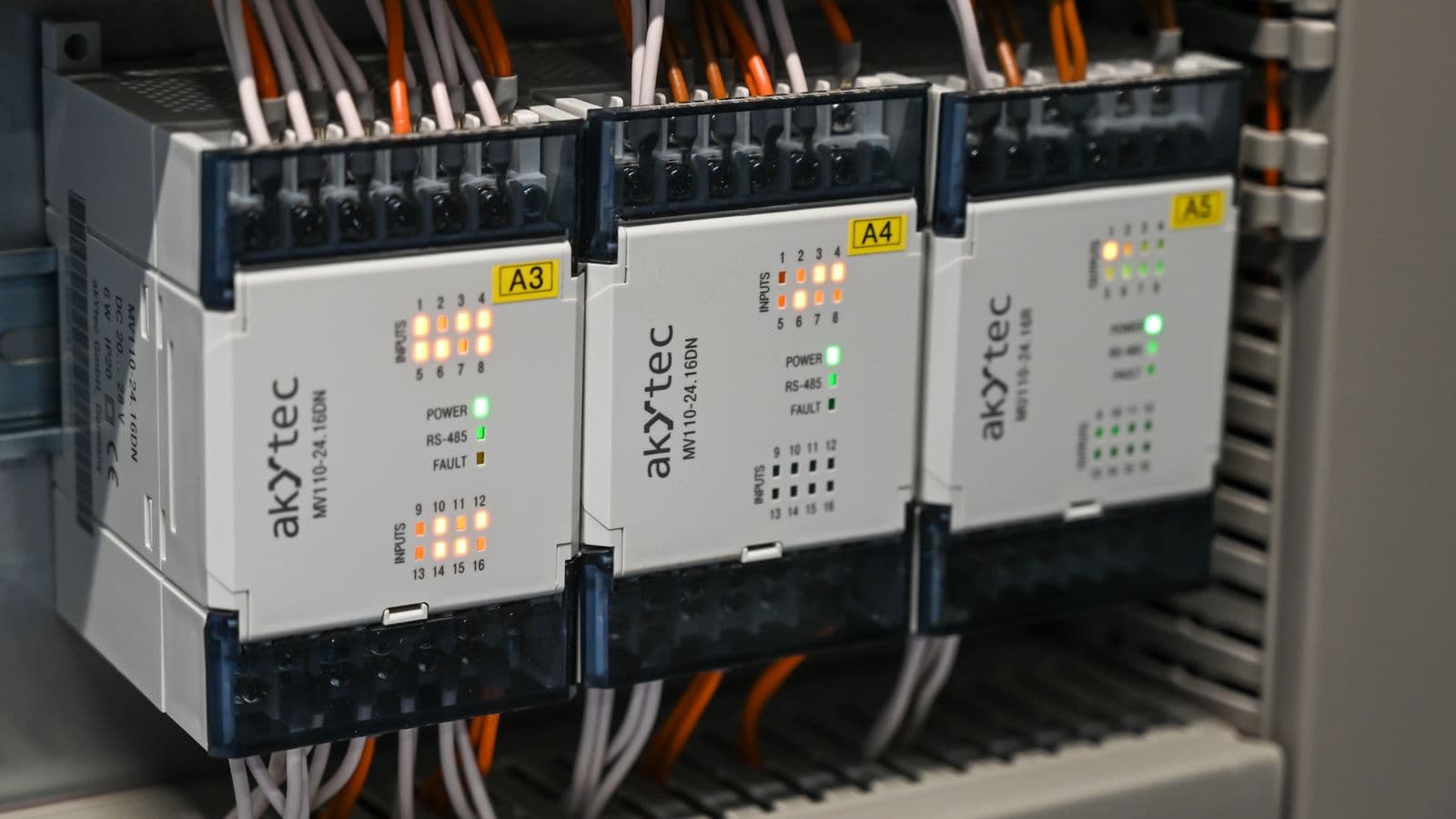
When a production line faults, the first question is usually: "which relay tripped?" Relay-based control panels work fine at a certain scale, but as machine count grows, sequencing gets more complex, and fault diagnosis starts eating hours instead of minutes, that approach becomes the plant's bottleneck. A PLC (Programmable Logic Controller) moves that complexity into software, fundamentally changing both reliability and repair speed. The problem is that most facility owners don't know when the switch is actually warranted, moving too early is wasted capital, moving too late means recurring downtime and lost output. This piece covers, technically, what a PLC does, the point at which it's genuinely necessary, and how it integrates into existing panels.
What a PLC Actually Does
A PLC is an industrial computer built to read signals from inputs (sensors, pushbuttons, limit switches), process them against pre-written logic, and drive outputs (contactors, valves, motors) accordingly. What separates it from an ordinary computer is hardware hardened against vibration, dust, temperature swings and electrical noise, plus a deterministic (predictably-timed) scan cycle.
The core mechanism is the scan cycle: the PLC continuously (1) reads all inputs, (2) processes the programmed logic, usually Ladder Diagram, sometimes Function Block or Structured Text, and (3) updates outputs, repeating this loop on the order of milliseconds. That cycle is what lets a line run synchronized with sub-second response times.
PLCs are modular: the CPU unit, digital/analog I/O cards, and communication modules (Modbus, Profinet, Ethernet/IP) are selected and expanded independently as needed. That means you can add I/O when scaling up a line without replacing the whole system.
Relay Logic vs. PLC: the Real Difference
Relay-based control implements every logical function, starting a motor, building an interlock, running a timer, with a physical relay, timing relay, or contactor. For small, fixed, rarely-changing applications (a single pump start-stop circuit, say), it still makes sense: it's cheap, needs no programming knowledge, and the fault point is visually traceable.
But where relay logic stops scaling is clear:
- Cost of change: modifying a production step means physically rewiring the panel. In a PLC, it's a code change of a few lines.
- Fault diagnosis: finding the failed element in a panel with 40-50 relays can take hours. A PLC's software-level status monitoring (I/O status, fault codes) gets you there in minutes.
- Physical footprint and reliability: relay contacts wear mechanically, and contact resistance drifts over time. A PLC's solid-state outputs don't have that wear mechanism.
- Data and integration: relay logic produces no production data. A PLC connected to SCADA automatically logs output counts, downtime, and fault history.
The practical threshold: if a facility's logic involves more than 10 relays/timers, or the production recipe/sequence changes several times a year, the cost of moving to a PLC typically pays for itself quickly.
Does Your Factory Actually Need a PLC?
You can answer this with three practical criteria:
- Sequencing complexity: does your machine execute multiple steps in order (fill → cap → label → palletize, for example)? If transitions between steps are conditional, sensor confirmation, timeout, fault check, a PLC is warranted.
- Interlock density: if safety or process interlocks (a door open should stop a motor, an empty tank should stop a pump) are interdependent and growing in number, relay logic becomes both unreliable and hard to verify.
- Frequency of change: if product recipe, line speed, or sequencing changes often, rewiring the panel every time is operationally unsustainable.
If two of these three criteria are "yes," a PLC investment typically pays for itself within 12-18 months through reduced downtime and easier maintenance. If none of them are strong (a simple, fixed, single-function circuit), relay logic is still a defensible choice.
Typical PLC Use Cases
- Machine sequencing: running a production line's steps in order, each conditional on the confirmation of the previous, a load, machine, unload cycle in a CNC cell, for example.
- Interlock management: managing dependencies between safety doors, emergency-stop chains, and process conditions centrally and auditably.
- Batch control: recipe-based control for discrete processes, mixing, heating, cooling a set quantity of raw material in a set sequence.
- Motor and drive coordination: synchronized starting of multiple motors (conveyors, pumps, fans), shared speed references, and a safe stop sequence on fault.
- Energy and process data collection: data gathered through the PLC can feed into SCADA for consumption and efficiency analysis, as covered in our energy monitoring guide.
What a PLC Programming Engagement Actually Involves
A PLC programming project typically moves through these stages:
- Process analysis and functional specification: documenting the existing machine/line process step by step, listing all inputs and outputs. Skip this stage and costly revisions down the line are almost guaranteed.
- Hardware selection and I/O design: choosing the CPU model, number and type of I/O cards (digital, analog, specialty modules), and communication protocol. If integrating into an existing panel, existing wiring and terminal layout are used as reference.
- Logic programming: writing the logic in Ladder Diagram (most common, readable by electrical technicians), Function Block Diagram, or Structured Text. Sequencing, interlocks, alarms, and fault handling are coded at this stage.
- Simulation and bench testing: before loading onto real hardware, the program is validated in a simulation environment or an isolated test rig.
- Field commissioning: the PLC is mounted in the panel, tested against real inputs/outputs, and safety interlocks are physically verified. This stage is usually done in a planned outage window.
- Documentation and training: program comments, an I/O list, and fault-response instructions are handed over to the facility; operators and maintenance staff are briefed on basic fault diagnosis.
Integrating into Existing Panels
You don't need to build a panel from scratch. In most retrofit projects, the PLC is added only to the control layer, while the existing power circuit (contactors, motor protection) stays untouched:
- Phased rollout: start with a non-critical line and expand scope once the PLC's reliability is field-verified.
- Reusing existing sensors and actuators: most limit switches, pushbuttons, and contactors can wire directly into PLC I/O, a major hardware refresh usually isn't necessary.
- Parallel run period: during transition, the old relay logic and the new PLC logic run in parallel for a defined period to reduce risk.
- Panel safety: the panel is evaluated against TS EN 61439-1 during integration, checking added modules' effect on short-circuit and thermal capacity.
This approach is the most cost-effective way to raise a facility's automation level without a full machine replacement, we cover it in more depth in our legacy machine automation retrofit guide.
PLC Brands and Compatibility Considerations
Common PLC brands include Siemens (S7 family), Allen-Bradley (Rockwell), Schneider Electric, Mitsubishi, and Omron. Brand selection is usually driven by:
- Existing equipment on site: if the facility already runs a particular brand, staying in the same ecosystem is an advantage for spare parts and technician familiarity.
- Regional service support: brands with strong support in Bursa and the Marmara region enable faster response in a fault situation.
- Communication compatibility: the protocol the PLC will use to talk to SCADA, HMI, and other field equipment (Modbus TCP, Profinet, Ethernet/IP) should be settled up front, or an extra gateway becomes necessary during integration.
Switching between PLC brands is possible but requires rewriting the logic, so brand choice should align with the facility's long-term automation strategy.
Safety and Standards Compliance
PLC-based control also brings safety advantages. Emergency-stop chains, door interlocks, and safety relays can integrate with the PLC, but Category 3/4 safety functions generally still require a dedicated, certified safety PLC or safety relay, standard PLC logic alone doesn't guarantee the required safety level. Every module added to the panel should be evaluated under TS EN 61439-1, and workplace safety requirements reviewed under Turkey's Occupational Health and Safety Law No. 6331.
Maintenance and Long-Term Cost
A PLC investment's return should be evaluated over the equipment's operating life, not just initial installation cost:
- Spare parts lifecycle: PLC CPUs and I/O modules typically carry 10-15 years of manufacturer support; modernization should be planned around that horizon.
- Program backups: failing to back up the PLC program risks losing all logic in a CPU failure, this is one of the most common oversights in the field.
- Remote access: modern PLCs support remote connections for fault diagnosis, shortening first-response time without a site visit.
As automation level increases, moving PLC data into SCADA for centralized monitoring is a natural next step, a topic we cover on our SCADA installation guide.
Common Mistakes
- Starting to program without a functional specification: logic written before the process is clearly defined requires constant field revision and extends commissioning time.
- Sizing I/O with no room to grow: not leaving spare channels for a sensor or actuator you'll add later forces a full I/O card replacement for a minor expansion.
- Skipping documentation: an uncommented, unexplained ladder program becomes unreadable to the maintenance team once the original engineer is gone.
- Leaving safety interlocks entirely to software: relying on standard PLC logic alone, instead of certified hardware, for critical safety functions creates risk for safety certification and insurance.
- Deploying without a program backup: an undocumented backup means a CPU failure can require rewriting all logic from scratch, days of lost production.
- Skipping the test stage and commissioning straight into production: logic tested only in the field, without simulation or an isolated rig, risks unexpected downtime during production.
FAQ
How long does PLC installation stop production? It depends on scope and line complexity; a small line might need only a few hours of planned downtime, while a multi-station line's commissioning can take several days. A phased transition approach typically minimizes this.
Do we need to fully replace our relay panel? No. In most cases the power circuit (contactors, motor protection) is retained, and only the control layer moves to the PLC. This significantly reduces both cost and downtime.
What happens if the PLC fails, does production stop entirely? A PLC failure can stop production, which is why critical lines should keep a spare CPU on hand, or at minimum an up-to-date program backup. In a well-designed system, fault diagnosis can be done in minutes.
Does a PLC investment make sense for a small operation? Even at small scale, if the production recipe changes frequently or interlock needs are dense, a PLC investment pays back quickly. For a fixed, single-function circuit, relay logic is still appropriate.
What training is provided after PLC programming? Operators receive basic operation and alarm-reading training; maintenance staff receive I/O status monitoring and basic fault-diagnosis training. Program documentation and the I/O list are handed over to the facility.
Can we connect the PLC to SCADA later? Yes, if the PLC was selected up front with the right communication protocol (Modbus, Profinet, Ethernet/IP), SCADA integration can be added later without issue. That's why planning the communication layer correctly at initial installation matters.
What standards apply to PLC programming? The panel housing the PLC falls under TS EN 61439-1, safety interlocks fall under relevant machine-safety requirements, and general workplace safety practice falls under Law No. 6331. The panel's short-circuit withstand is evaluated against IEC 60909-0:2016.
Does the age of our existing machine block PLC integration? Usually not. As long as the machine is mechanically sound, adding a PLC to the control layer is a common, cost-effective retrofit method, it doesn't shorten the machine's physical life, it improves control quality.
A PLC is the first and most fundamental step in moving a facility toward automation. Sized correctly, scoped against a real functional specification, and integrated in phases into the existing panel, it directly improves both fault-diagnosis time and production flexibility.
Let's talk through this together
The SOREAS engineering team can assess what's covered here for your specific facility. Reach out via the contact form or call us directly.