
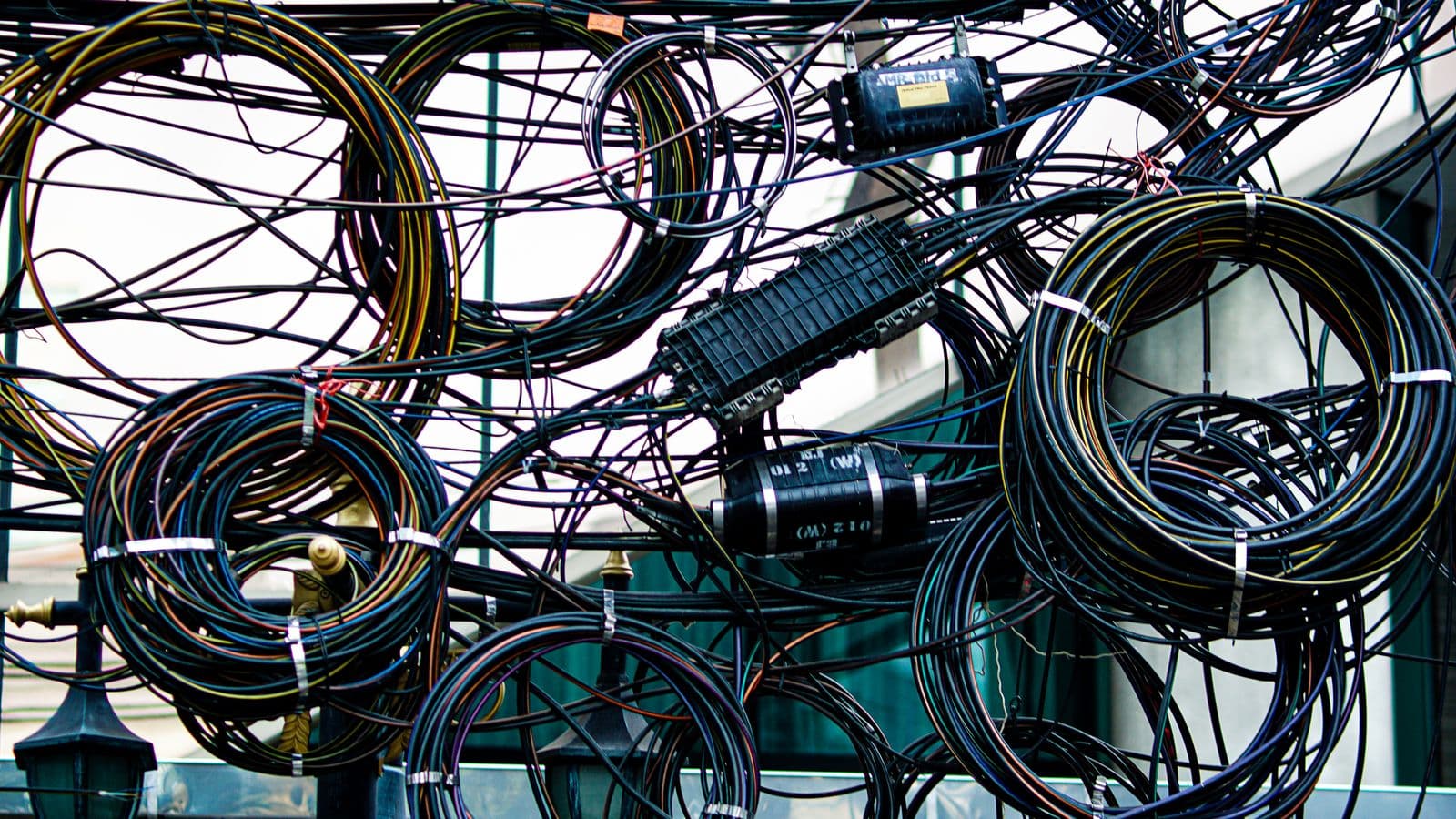
Most of the factory electrical failures we've seen in the field over the years don't come from complex engineering errors, they come from simple mistakes made during installation that go unnoticed for months. These mistakes show no symptoms in the early days; they sit quietly inside a panel, a cable route, or a breaker setting, and they tend to surface during the busiest production period, at the worst possible time. Worse, these mistakes aren't independent of each other: poor labeling extends the time it takes to find the right breaker during a fault, and combined with missing lockout-tagout, a routine maintenance job can turn into a serious accident. This post covers eight concrete mistakes we see repeatedly in the field across Bursa's OIZs, why each one is a problem, and the correct fix.
1. Undersized Feeders
The problem: Cable cross-section is sized against the current load calculation alone, without accounting for future expansion or the real current-carrying conditions, installation method, ambient temperature, group-installation correction factors.
Why it's a problem: The cable looks like it "works" in the short term because overheating doesn't cause an immediate fault, the damage accumulates over months or years. By the time it's noticed, it has usually progressed far enough to require replacing the cable entirely.
The fix: Feeder cross-section should be selected per TS HD 60364-5-52, weighing rated current, installation-method correction factors, ambient temperature and voltage-drop limits together, with margin left for future load growth.
2. Poor or Missing Labeling
The problem: Breakers, cable ends and machine feeder lines in panels are left unlabeled or inconsistently labeled, with no clear indication of which circuit they feed.
Why it's a problem: During a fault, finding the right breaker can take minutes, a delay that matters in an emergency (fire starting, electric-shock risk). It can also lead maintenance staff to believe they've isolated the correct circuit when they're actually about to work on a live one.
The fix: Every breaker, cable and feeder line should carry a permanent, legible label, backed by an up-to-date single-line diagram and cable schedule.
3. Wrong IP Rating for the Environment
The problem: Panels and junction boxes get chosen based on a standard or cheapest option, rather than the real conditions of the space they'll sit in, dust, moisture, washdown, chemical vapor.
Why it's a problem: A panel with an inadequate IP rating gradually lets in dust or moisture, causing corrosion and insulation breakdown at internal connections, eventually leading to a short circuit. These failures usually surface months after installation, at the least convenient moment.
The fix: Panel and box IP rating should match the real ambient conditions of the installation area, a regularly washed-down production space, for example, calls for IP65 or higher, and not just the enclosure but the cable glands and gasket details need to match the same standard.
4. Missing Strain Relief at Cable Entries
The problem: Cables are connected directly into a panel or machine entry point without mechanical fixing or strain relief.
Why it's a problem: Especially near vibrating machinery or moving equipment, an unrelieved cable entry point develops mechanical fatigue over time; the cable loosens at the terminal or cracks in its jacket. This leads to heating at the loose connection and, eventually, failure.
The fix: Every cable entry should use a proper gland and strain relief; flexible cable or spiral protection should be used at vibration-prone points.
5. Daisy-Chained Extension Cords
The problem: When extra load capacity is needed, instead of a permanent fix, extension cords get chained into outlets as a "temporary" connection, one that often becomes permanent.
Why it's a problem: Daisy-chaining adds a voltage drop and heating risk at every extra connection point; the total current running through it can easily exceed a single extension cord's rated capacity. That means both a fire risk and equipment running at inadequate voltage.
The fix: When extra load capacity is needed, it should be solved with a permanent feeder and, if necessary, a new sub-panel; extension cords should only be used for genuinely temporary, short-duration needs at the correct rating.
6. Missing Lockout-Tagout (LOTO) Practice
The problem: During maintenance or fault response, even when the relevant circuit is de-energized, no physical lockout or tagging is applied, leaving the door open for someone (or an automated system) to accidentally re-energize the circuit.
Why it's a problem: Work without LOTO can put the maintenance worker at serious risk of electric shock without realizing they're working on a live line. It's among the leading causes of severe industrial accidents.
The fix: Under Law No. 6331 on Occupational Health and Safety, every maintenance or fault-response task should begin with de-energizing the relevant circuit, physically locking it out, and tagging it with who locked it and when, the lock should only be removable by the person who applied it.
7. Mixing Power, Control and Signal Cabling on the Same Route
The problem: Power cables and control/signal cables run together in the same tray or ladder with no separation.
Why it's a problem: The electromagnetic field power cables generate can induce interference and misreadings in nearby sensitive signal cables (analog measurement, communication lines). This shows up as unexplained intermittent faults in the automation system, one of the hardest fault types to diagnose because the source sits in the cable routing rather than the equipment itself. We cover this in more depth in our cable tray and ladder selection guide.
The fix: Power, control and signal cabling should run on separate routes, or at minimum in physically separated bundles, ideally with a metal separator between them.
8. Deferred Periodic Maintenance and Measurements
The problem: Periodic checks, earthing measurement, insulation testing, thermal-camera scanning, keep getting postponed or skipped entirely under production pressure.
Why it's a problem: Most degradation in an electrical installation (a loosening connection, rising earth resistance, aging insulation) progresses slowly and silently; without periodic measurement, it's only noticed once a fault actually occurs. At that point the cost compounds, unplanned production stoppage plus emergency repair.
The fix: Earthing measurement, insulation resistance testing and thermal-camera scanning should sit on an annual maintenance calendar that runs independently of production scheduling, our earthing measurement guide covers in detail why periodic measurement shouldn't be skipped.
How These Mistakes Get Caught in the Field
Most of these eight mistakes aren't visible to the naked eye while the facility is running normally, which is why a systematic audit approach matters. The core steps we apply on-site:
- Thermal-camera scanning: Panels and cable connection points are scanned while energized; loose connections, undersized feeders and overloaded circuits show up as abnormal heat relative to their surroundings. This catches most instances of mistakes #1 and #4 that are otherwise invisible.
- Visual panel inspection: Presence of strain relief at cable entries, correct gaskets and glands for the IP rating, labeling consistency and daisy-chained extensions are all checked at this stage.
- Labeling vs. documentation cross-check: Physical labels in the field are compared against the current single-line diagram and cable schedule; discrepancies get logged.
- LOTO practice audit: We observe whether the maintenance team actually applies lockout-tagout in practice, a procedure existing on paper isn't enough; it needs to be verified in the field.
- Periodic measurement record review: Dates on earthing measurement and insulation test reports are checked; deferred or missing measurements surface at this stage.
These audit steps can usually be completed in a single day on site without stopping production. Findings are turned into a prioritized correction plan, starting with the highest-risk items, missing LOTO, undersized feeders, first.
What These Mistakes Have in Common
The common thread across all eight is that none of them are noticed on day one of installation. Undersized cable, poor labeling, deferred maintenance, all of them accumulate silently while the facility looks like it's "working," and they usually turn into a failure during the busiest production period, at the least convenient moment. That's why quality control in a factory electrical installation shouldn't stop at "power's on, it works" at commissioning, it needs to be an ongoing discipline of periodic verification.
FAQ
Which of these mistakes is the most dangerous? Missing LOTO practice, because it directly concerns life safety; the others typically lead to equipment damage and production loss, but a LOTO gap carries a serious risk of severe injury.
How are these mistakes detected in an existing facility? A comprehensive electrical audit, labeling check, thermal-camera scan, insulation testing, visual panel inspection, surfaces most of these mistakes.
Does an undersized feeder always show a visible symptom? No, overheating is often invisible to the eye; a thermal-camera scan can catch it as a temperature rise, which is why periodic thermal inspection matters.
Is using a daisy-chained extension cord illegal? Not categorically, but using one for a permanent load need is unsound from both a safety and an engineering standpoint; permanent needs should be solved with a permanent feeder.
What's the symptom of a wrong IP rating? Usually moisture traces inside the panel, early corrosion, or unexpected breaker trips, once these appear, the IP rating should be reassessed without delay.
Does fixing these mistakes require stopping production? Most fixes (labeling, adding strain relief, establishing a LOTO procedure) can be done without stopping production; some interventions, like changing feeder cross-section, may require a planned outage.
How often should periodic maintenance happen? Earthing measurement and insulation testing are typically annual; thermal-camera scanning is recommended more often (every six months) on critical panels, operating conditions affect this frequency.
What's the most effective way to prevent these mistakes altogether? Applying an engineering-based checklist during installation and not neglecting periodic maintenance afterward, together, these two prevent nearly all eight mistakes from the start.
Conclusion
What these eight mistakes in factory electrical installations have in common is that none of them are technically hard to catch, they're preventable from the start with the right checklist and discipline. The problem usually isn't a knowledge gap; it's an approach that prioritizes installation speed. SOREAS systematically screens for and corrects these eight mistakes as part of our standard checklist, both in new installations and in audits of existing facilities across Bursa's factories and OIZs.
Let's talk through this together
The SOREAS engineering team can assess what's covered here for your specific facility. Reach out via the contact form or call us directly.