
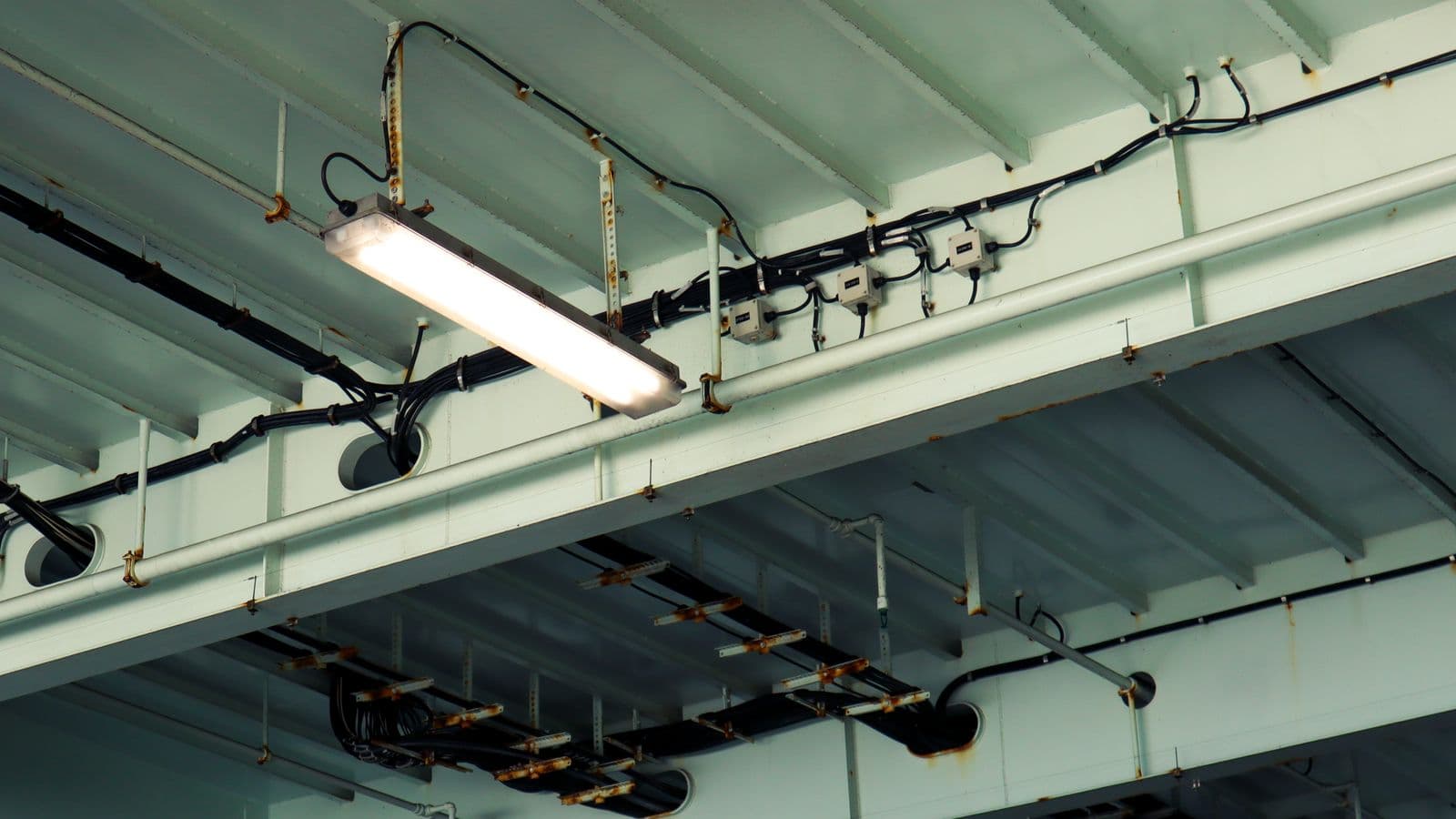
Lighting is often overlooked, yet inadequate lighting both lowers productivity and raises the risk of accidents. And it isn't a comfort matter; it's a regulatory requirement with measurable limits.
The Real Cost of Inadequate Lighting
Low or uneven lighting causes eye fatigue, loss of focus and higher error rates. In warehouses and production areas, this translates directly into accident risk, a significant share of slips, forklift collisions and manual-handling incidents happen under poor visibility. In precision work like quality control and assembly, inadequate lighting directly raises defect rates and returns.
The Legal Framework
Turkey's Regulation on Health & Safety Measures in Workplace Buildings ties workplace lighting directly to the TS EN 12464-1 standard (Article 22). In other words, inadequate lighting isn't a matter of preference, it's also an OHS non-conformity, and one that gets checked directly in OHS audits.
What TS EN 12464-1:2021 Says
The standard defines minimum values per type of work area:
- Em (illuminance): the minimum lux the task requires, general office work and precision assembly-line work call for very different Em targets.
- Uo (uniformity): even distribution of light across the area, some zones being over-lit while others stay dim doesn't conform.
- UGR (glare): the limit for disturbing glare, critical in screen-based work and precision visual tasks.
- Ra (colour rendering): colours appearing correctly, decisive in quality control, paint and textile work where colour discrimination matters.
An assembly line, warehouse, office and laboratory each need different values. "It looks bright enough" is not a measured conformity, the eye adapts quickly to different light levels, so it can miss a real deficiency.
How is Lighting Measured?
Using a certified lux meter, the work area is divided into a grid plan and readings are taken at defined points. This lets us calculate both the average illuminance (Em) and the uniformity ratio (Uo). Results are compared against the minimum values the standard sets for that area's use, and turned into a conformity report.
What SOREAS Does
- Assesses existing lighting with a point-by-point lux measurement
- Reports conformity against TS EN 12464-1:2021
- Where inadequate, offers a concrete solution via luminaire selection, positioning and count calculation
- With energy-efficient LED conversion, meets the standard and lowers the bill
- Also assesses complementary OHS requirements like emergency lighting and escape-route signage
Why LED Conversion is Usually the Right Move
Old fluorescent or mercury-vapor fixtures are both inefficient and lose light output over time (lumen maintenance factor). LED conversion delivers the same or higher Em at lower energy consumption, securing TS EN 12464-1 conformity while cutting lighting energy cost. But an LED conversion done without correct luminaire selection and a layout plan is just a lamp swap and may still fail the standard, which is why measurement and calculation before conversion is essential.
FAQ
How often should lighting be measured? Since luminaire output degrades over time and area use can change, periodic re-measurement is recommended, especially after a layout change or fixture replacement.
Is increasing bulb wattage enough on its own? No. High-power but poorly positioned fixtures can still fail uniformity (Uo) and glare (UGR) requirements; the correct fix requires measurement and a layout calculation.
Does LED conversion automatically ensure OHS conformity? No, swapping the product alone isn't enough. Reaching the correct Em, Uo and UGR values requires calculating luminaire selection, count and layout, then verifying with measurement.
Which areas is lighting measurement most critical for? Production lines, quality-control stations, warehouse aisles and stairwells/escape routes, the areas carrying the highest risk for both productivity and safety.
Let's talk through this together
The SOREAS engineering team can assess what's covered here for your specific facility. Reach out via the contact form or call us directly.